Less time on the phone, more time for animals
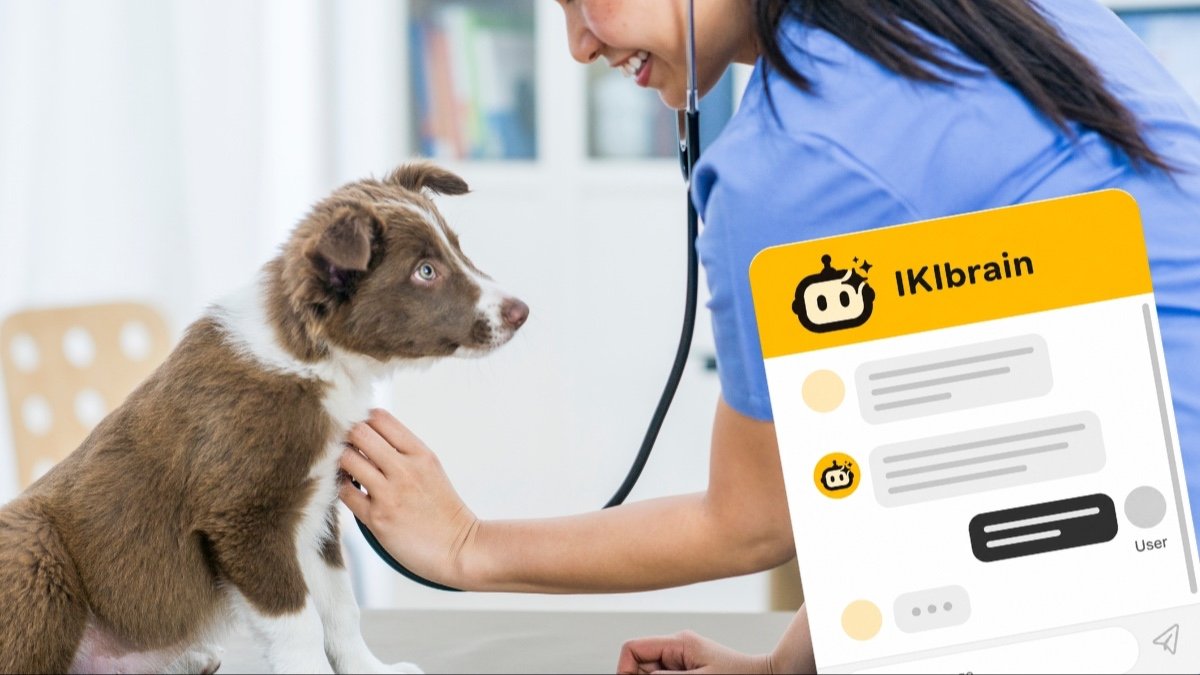
The problem
Every day, you get the same questions about vaccinations, neutering, documents, how to prepare for a visit, and feeding. Your staff wastes time on simple requests and has less time for the cases that really need attention.
The solution
IKIbrain automatically answers recurring questions using only the information in your knowledge base. If a detail is not there, it says so clearly and invites people to contact the practice directly.
The next day, you find the messages that came in while the practice was closed. One person asked whether a puppy can be vaccinated right after finishing a treatment. Another wanted to know which documents are needed to take a cat abroad. Someone else wrote to ask how to prepare a dog for neutering. By the time you call back, the potential client’s need has often already cooled off, or they have found an answer elsewhere.
For a veterinary clinic or practice, this does not just mean losing time on repetitive questions. It also means pulling attention away from the front desk, interrupting work in the consultation room, and leaving requests pending when the pet owner sees them as urgent, even if they are not true emergencies. This is where an AI chatbot for Veterinary can become useful, if it works the right way.
Not to replace the vet or the reception team, but to keep requests organised, answer clients 24/7, and collect contact details when a human follow-up is needed. In this guide, you will see how an AI assistant like IKIbrain can support your day-to-day work, which questions it can handle, and why the fact that it never makes things up is a real advantage for a veterinary practice like yours.
An AI chatbot for Veterinary takes the pressure off repetitive requests
Anyone working in veterinary care knows this well: many conversations start the same way every time. Opening hours, appointments, pre-op preparation, vaccine boosters, microchips, European pet passports, certificates, stool tests, and more. These are all legitimate requests, but they take up time every day and the answers are usually the same.
A well-configured chatbot for Veterinary does not diagnose and does not replace clinical judgement. What it does do is help you manage everything related to informational support: it explains what you have already published on your website, in FAQs, in informational PDFs, or in internal documents you want to use as the knowledge base.
That means fewer unnecessary calls, fewer informational messages, and less pressure on your reception team. Your staff can focus better on the patients already in the practice and on the cases that truly require human attention.
Answers that stay consistent with your clinic’s procedures
Every practice has different routines, services, and operating guidelines. Some only see patients by appointment, some have dedicated check-up slots, some handle dogs, cats, and exotics separately, and some require specific forms before a procedure. That is why a generic virtual assistant is not enough. You need a tailored AI agent.
IKIbrain is configured on the real content of your business. It can use website pages, Word documents, informational PDFs, presentations, FAQs, and any text you provide. That way, the conversational assistant does not answer in a vague or generic way, but according to what you have chosen to communicate to your clients.
For example, if your website explains how to prepare an animal for a specialist visit or which tests to bring for a consultation, the digital assistant will use that information. If you update the instructions, you only need to update the knowledge base and it adapts.
Artificial intelligence is useful when it does not improvise
In veterinary care, accuracy matters. Wrong information about medication, test preparation, or health documents can create confusion, delays, or false expectations. That is why IKIbrain uses RAG technology, short for Retrieval-Augmented Generation.
In practice, the artificial intelligence does not pull random answers from the web and does not try to guess. It first looks through the sources you have provided and answers only on the basis of that content. If a piece of information is not there, it says so clearly and invites the client to contact the practice directly.
That is also important for trust. An AI agent for Veterinary needs to know where to stop. If the client asks something that is not in the knowledge base, it does not fill the gaps with vague wording. This helps you keep communication more orderly and more consistent with the way you work.
To better understand the technical setup, you can learn more on the how it works page.
A realistic example of customer support for a veterinary clinic
The useful part is not just the instant reply. It is also the fact that the client feels looked after even outside business hours, and the request arrives already clearer, with the details your team needs to handle it.
“Good morning, I need to bring my 8-year-old mixed-breed dog in for a dental cleaning. I’d like to know whether you do a check-up first, whether fasting is required, and whether I can leave a contact number so someone can call me back.”
“Of course. Based on the practice information, a clinical assessment is required before the dental cleaning. The pre-procedure preparation includes specific instructions, which may vary depending on the case. If you’d like, leave your name and phone number: I’ll collect your request and forward it so the practice can call you back with the correct instructions and confirm the next steps.”
That is the point: the AI assistant informs and organises the request, without pretending to do what belongs to the veterinary team or the front desk. For a veterinary practice, that is often the most useful balance between speed and control.
The actual booking still stays in your hands
This is the most common objection, and it is right to address it clearly. By default, IKIbrain does not book visits, does not schedule appointments, and does not take service orders. It collects the request and the contact details, and you or your team call the client back to confirm.
For a veterinary clinic, that is often a sensible choice. Before an appointment is confirmed, you may need to understand the type of service, check which vet is available, assess urgency and duration, or request documents and preliminary information.
The actual booking still stays in your hands: IKIbrain collects the request and the contact details, and you or your team call the client back to confirm. If connected to your calendar or booking system, full automation is possible, but it is a dedicated setup and depends on the system you use.
In other words: as a virtual assistant for Veterinary, its standard job is to filter, inform, and hand over when needed. If you want to explore more advanced connections, we can do that, but feasibility depends on a few technical aspects that need to be checked in advance.
Multilingual support, the right tone, and handoff to human channels
Not every client writes in the same way. Some use precise language, some send an anxious message, and some write in English because they have recently moved abroad and need to understand how a first visit works. A digital assistant for your website needs to adapt without losing clarity.
IKIbrain understands and replies in multiple languages, even if the source content is only in Italian. This can be useful in tourist areas, in cities with many international residents, or in practices that support clients with travel documents and pet relocation needs.
On top of that, the team configures the assistant’s tone of voice, behaviour rules, and personality. If you want communication that feels more reassuring, more concise, or more formal, you do not need to do anything technical: we take care of everything. And when the conversation needs a human touch, the assistant can collect the contact details and direct people to phone, email, or WhatsApp.
- The client gets an initial reply even outside business hours.
- You receive requests that are more organised and easier to manage.
- Your team steps in where their time is really needed.
A simple integration for any website
Many veterinary practices have websites built at different times, maybe on WordPress, Wix, or custom tools. That should not become a barrier. IKIbrain integrates with a simple code snippet and works with any website.
The value, though, is not only technical. It is organisational. You do not need to design flows, write prompts, or set up complicated rules. The team prepares the AI assistant based on your content, your way of working, and the type of requests you receive most often. If you want a closer look at what can be configured, you can find an overview in the features.
For a veterinary practice, having a clear and consistent response point on your website means not leaving requests unanswered when you are in consultation, in surgery, or simply closed for the day or over the weekend. An artificial intelligence-based chatbot, when built on your real content, helps you keep online support going without losing control of the information.